
Guardsman Air Duct Cleaning in Chatsworth: A Homeowner’s Guide
Guardsman air duct cleaning in Chatsworth is a particular method of negative-pressure duct cleaning, not a different service. The name on the van tells you which equipment is being wheeled in, but the result depends almost entirely on whether the technician uses that equipment in the correct sequence. Here’s what that machine actually does inside your ducts, what a proper job looks like from your side of the register, and what to watch for if someone shows up with one.
If you’d rather skip the technical breakdown and just get a straight answer on your own system, call (888) 494-4745. We answer 24/7. Fast dispatch from 7am to 7pm, Sunday through Friday.
What Guardsman Equipment Actually Does Inside Your Ducts
Most homeowners in Chatsworth picture duct cleaning as a fancy vacuum hose shoved into a vent. That’s the low-bid version, and it does almost nothing. A Guardsman setup works differently. It creates negative pressure, which is the technical way of saying it pulls air out of your duct system harder than the air around it can push back in. That pressure differential is what loosens debris from the duct walls and carries it out to the collection unit.
Think of it like this: a shop vac shoved into one register only cleans what’s within a few feet of that opening. Negative-pressure equipment, the kind built into Guardsman units and the Rotobrush and Nikro systems we run, depressurizes the entire duct run. Every register gets sealed or worked in sequence, so the airflow moves through the whole system rather than sitting stagnant in the middle. In Chatsworth, where a lot of homes were built between the 1950s and 1980s, those long rectangular trunk lines hold more debris than homeowners expect. Negative pressure is the only way to dislodge it without tearing out drywall.
The extraction side matters just as much. A properly set up Guardsman job routes the exhaust through HEPA filtration before it leaves the machine. That means the fine particulate pulled out of your ducts doesn’t end up floating back into your living room. If the exhaust is just venting out an open window or, worse, into the garage, you’re watching a contamination event, not a cleaning.
The Agitation-to-Extraction Sequence: Why Order Matters
Here’s the part most homeowners never hear about, and it’s the difference between a legitimate air duct cleaning and a very expensive way to stir up dust.
The correct process is extraction first, agitation second, extraction ongoing. The vacuum source has to be running and pulling negative pressure before any brush, whip, or air wand goes into the duct. When you agitate debris while suction is already active, the loosened material flows toward the collection unit. Simple mechanics.
Run the agitation without sufficient vacuum already running, and you’ve just made the problem worse. Brushes spinning inside a duct without extraction force the debris airborne. It resettles deeper in the system, coats the coil, or pushes out through the registers into the home. A technician who runs a brush for ten minutes and then turns on the vacuum is doing it backwards. That’s not a judgment call; it’s airflow physics. In Chatsworth homes with older fiberglass duct board, that kind of backwards sequence grinds fine particulates into the insulation layer, where it’s nearly impossible to remove later.
What you can observe from the homeowner’s side: before the technician starts agitating, you should hear the vacuum system running and see hoses connected to the main trunk, not just a single floor register. If the brush is going before the vacuum comes on, ask them to stop and explain the sequence. A legitimate operator won’t hesitate to walk you through it.
What a Proper Guardsman Job Looks Like From Your Side
You don’t need to hover over the technician’s shoulder, but you should know what a correct setup looks like. Here’s the sequence as it should unfold in a typical Chatsworth home.
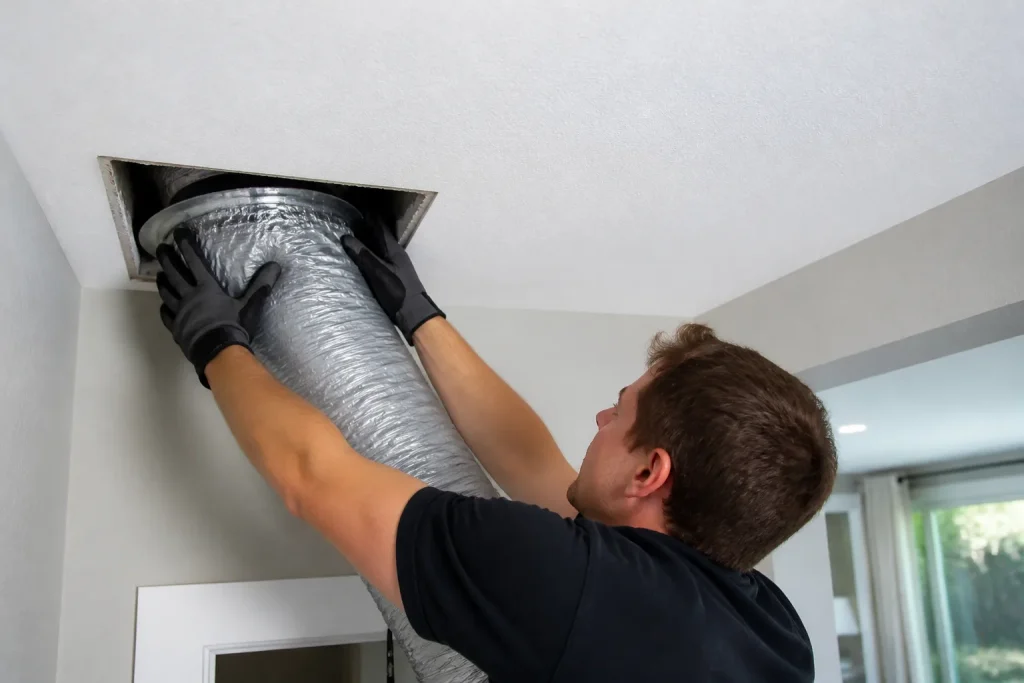
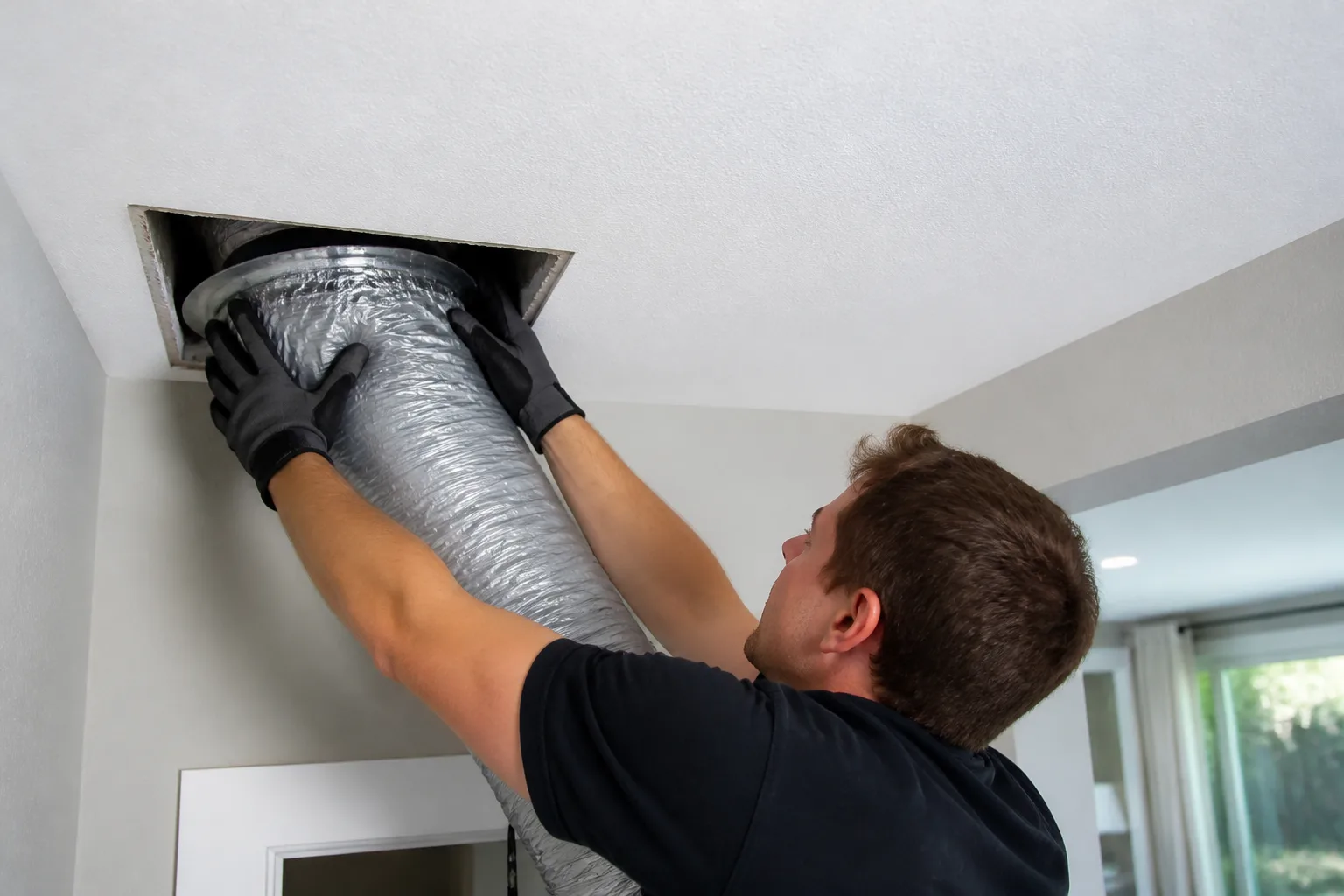
First, access. The technician needs to cut or open an access point into the main supply and return trunks, typically just downstream of the air handler. This isn’t optional. A cleaning done entirely through floor registers without opening the trunk is close to pointless for the main lines. In many Chatsworth homes, the furnace is in a hall closet or garage, which makes access straightforward. If it’s in a tight attic space, the job takes longer, and a good technician will tell you that up front.
Second, register sealing. The registers that aren’t actively being worked get sealed off, usually with magnetic covers or foam blocks. This forces the negative pressure to concentrate in the section being cleaned rather than pulling air from every open vent in the house, which dilutes the force and leaves the far ends of the system untouched.
Third, the exhaust. The collection unit should be routed so the outflow goes through HEPA filtration and stays inside the containment area. Out an open window is not containment, and in Chatsworth’s summer heat, technicians are often tempted to cut that corner just to keep the workspace cooler. Don’t let that happen.
Finally, the walkthrough. When the job is done, you should be able to see, with a camera or a flashlight at minimum, that the interior surfaces of the main trunks are visibly cleaner. We show before-and-after photos of the actual duct interior on every job because if a company can’t show you the inside of your own ducts, you have no way to verify the work happened.
Red Flags That Mean the Equipment Is Present but the Process Is Wrong
Having a Guardsman unit on site is not a guarantee of a proper cleaning. Here’s what Chatsworth homeowners should watch for, none of which requires touching anything or knowing how to run the machine.
- 1
The vacuum starts after the brush. Covered above, but worth repeating because it’s the most common mistake. Negative pressure must be established first. If you hear a brush spinning but no vacuum running, that’s wrong.
- 2
One access point, no trunk opening. If the technician never opens the main trunk line and only works through registers, they’re doing a surface cleaning. The bulk of the debris in a typical Chatsworth system sits in the trunk, not the branch runs.
- 3
Visible dust exiting registers during the job. Some airborne particulate is unavoidable, but if you can watch a cloud of dust coming out of a register while the technician works, the negative pressure isn’t doing its job. The airflow should be pulling inward, not pushing outward.
- 4
Filters that look like they’ve never been changed. This one requires you to ask a question, not touch anything. Professional equipment has pre-filters and HEPA filters that need servicing between jobs. If the technician can’t quickly tell you when the filters on their own machine were last cleaned or replaced, that’s a problem. A clogged HEPA filter reduces airflow, which reduces negative pressure, which means your cleaning is running at half strength.
- 5
No before-and-after visual. Any legitimate company working in 2026 can show you the interior of your ducts. If they won’t, ask why.
These aren’t theoretical concerns. In Chatsworth’s housing stock, where decades of dust, pet hair, and renovation debris accumulate in systems that have often never been properly cleaned, a weak process leaves the worst material behind. The equipment brand doesn’t save you if the procedure is sloppy.
Equipment Maintenance Between Jobs: What to Ask Before Work Starts
This is the question almost no one asks, and it’s the one that separates a serious operation from a van with a logo. Professional duct cleaning equipment, whether it’s a Guardsman negative-pressure unit, a Rotobrush system, or Abatement Technologies gear, requires its own maintenance. The machine that cleans your ducts is itself collecting the same fine particulate you’re paying to remove. If its filters aren’t serviced, the machine loses suction. Lost suction means lost negative pressure. You see where this is going.
Before work begins, ask the technician two things. When were the pre-filters on this unit last cleaned? When was the HEPA filter last replaced or inspected? There’s no magic timeframe that works universally, because it depends on how many jobs the equipment has run and what kind of debris it’s been pulling. But the technician should have an answer. A blank stare or vague mumbling is not an answer.
We run Rotobrush and Nikro platforms precisely because they’re designed for this kind of ongoing service. The filter access is straightforward, and the performance drop-off is predictable if you know the equipment. We also keep Abatement Technologies units on hand for jobs where the duct environment has heavier contamination, because running a standard cleaning unit through badly compromised ductwork is how you end up with cross-contamination between the machine and the next customer’s home.
None of this is glamorous, but it’s the part of the industry that actually determines whether your duct cleaning does anything. The machine brand gets the sale. The filter maintenance gets the result.
How Guardsman Fits Into the Bigger Indoor Air Picture
A duct cleaning is not a permanent solution to indoor air quality. It’s a reset. The debris that’s currently sitting in your ductwork gets removed, which immediately reduces what’s circulating through your living space. But your HVAC system pulls in new air every day, and that air carries new particulate. In Chatsworth, that means dust from the surrounding dry hills, construction debris from infill development, and whatever’s already in your home’s air between filter changes.
That’s why we look at duct cleaning as the first step, not the whole job. If we find compromised ductwork, a crushed branch run, a failing connection, a poorly sealed return, we can address it through Duct Cleaning Chatsworth‘s repair service rather than handing you a list of problems and a phone number for another contractor. Clean ducts with a leak between the return and the attic aren’t clean for long. The system pulls in whatever’s up there.
For homeowners who want to go further, we’re familiar with Honeywell and Aprilaire filtration products, which slot in after the ducts are clean and actually extend the benefit. A high-efficiency media filter or an electronic air cleaner does more when the ductwork it’s protecting isn’t already caked with years of accumulated debris. It’s a sequence question, same as the agitation-to-extraction rule. Clean first, then filter, because a filter can only catch what reaches it.
If your dryer is also part of the picture, and in many Chatsworth homes the laundry is tucked right next to the furnace closet, that’s a separate conversation worth having. We treat dryer vent cleaning as its own safety service, not an add-on we mention in passing. Lint-clogged vents are a fire hazard, and the fix is specific equipment and a specific process. It deserves its own appointment, its own equipment, and its own standards.
The Bottom Line
Guardsman air duct cleaning in Chatsworth is only as good as the technician running the machine and the condition of the equipment’s filters. The brand name signals professional-grade negative-pressure capability, but the process is what converts that capability into actually cleaner ducts. Negative pressure first, agitation second, extraction throughout. An open trunk line, sealed registers, HEPA-filtered exhaust. Before-and-after photos of your own system. If any of those are missing, you’re paying for activity, not results.
Key takeaways for Chatsworth homeowners:
- Guardsman equipment creates negative pressure that pulls debris from the entire duct run, not just the area near a single register.
- The vacuum must be running before any brush or agitation tool enters the duct. Backwards sequence makes the problem worse.
- A proper job includes trunk line access, register sealing, and HEPA-filtered exhaust.
- Ask when the technician’s own equipment filters were last serviced. A dirty machine can’t clean your ducts.
- Duct cleaning is a reset, not a permanent fix. Repairs and filtration extend the result.
If you’re in Chatsworth and want a straight answer about your ductwork, Duct Cleaning Chatsworth offers free estimates. Call (888) 494-4745. We answer 24/7. Fast dispatch from 7am to 7pm, Sunday through Friday.
Frequently Asked Questions
Worth depends on whether the equipment is used correctly. Guardsman negative-pressure units are professional-grade and capable of a legitimate whole-system cleaning, which a shop vac or consumer-grade unit is not. But the machine only works if the technician follows the correct sequence, pressure first, agitation second, and maintains the filters. A Guardsman unit operated poorly won’t outperform a well-used Rotobrush or Nikro system. Judge the process before you judge the brand. Call (888) 494-4745 for a free estimate in Chatsworth.
A typical single-system home with accessible ductwork runs roughly three to five hours. Larger Chatsworth properties, or homes where the furnace is in a tight attic or crawlspace, take longer. If a company promises a full-system cleaning in under two hours, they’re skipping steps. The estimate should tell you the scope before work starts. Call (888) 494-4745 for a written estimate.
If the ductwork is genuinely loaded with debris, yes, a proper negative-pressure cleaning will meaningfully reduce what’s circulating through your registers. But ducts are not the only dust source in a home. If the system has leaks pulling in attic air, or the return is drawing unfiltered air from a garage, dust will return regardless of how clean the ducts are. That’s why we check for those conditions during the walkthrough and can handle repairs rather than leaving you with a clean system that re-contaminates in three months. Call (888) 494-4745 to talk it through.
Guardsman is one brand of negative-pressure duct cleaning equipment. We run Rotobrush and Nikro systems, with Abatement Technologies units for heavier contamination jobs. They’re all professional-grade platforms built on the same mechanical principles: negative pressure, agitation, HEPA-filtered extraction. The differences come down to which tool fits the specific system, not which brand name is on the side panel. What matters is that the equipment is properly maintained and the process is correct. Call (888) 494-4745 for an honest assessment of what your Chatsworth system actually needs.
Written by the team at Duct Cleaning Chatsworth, serving Chatsworth since 2017.
Need Air Duct Cleaning Help?
Call Duct Cleaning Chatsworth - licensed & insured, here with fast help in Chatsworth.
(888) 494-4745